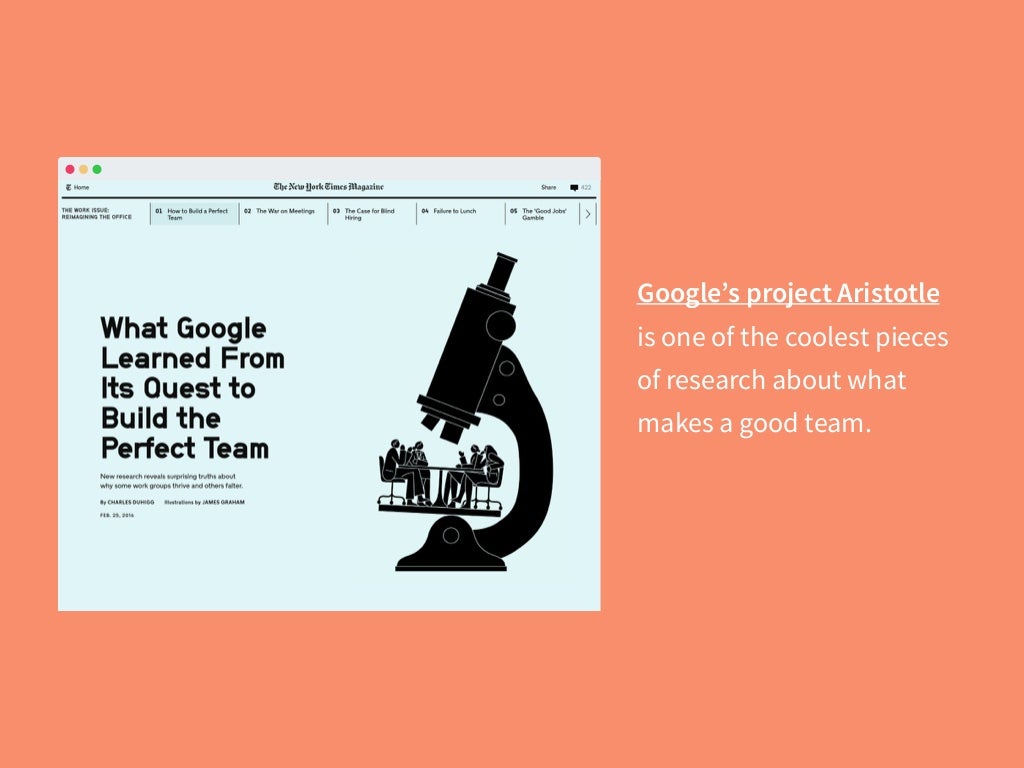
what Google Learned From Its Quest to Build the Perfect Team?
- ut five, eight, 12 or more people together in a room, and it’s a crapshoot as to how well they’ll function as a team. The larger the group, the more difficult it becomes.
The key characteristics of ‘enhanced teams?
- Psychological safety: Everyone feels safe in taking risks around their team members, and that they won’t be embarrassed or punished for doing so.
- Dependability: Everyone completes quality work on time. Structure and clarity: Everyone knows what their specific expectations are. These expectations must be challenging yet attainable.
- Meaning: Everyone has a sense of purpose in their work (i.e., financial security, supporting family, helping the team succeed, etc.).
- Impact: Everyone sees that the result of their work actually contributes to the organization’s overall goals.
Not all researchers agree?
-
While Google’s findings may be true to some extent, a large number of scientific studies have caused researchers (outside of Google’s lab) to shockingly disagree. They claim the exact opposite — that personality, not just skills, is indeed a significant factor in what makes a team successful.
-
Tomas Chamorro-Premuzic, a professor of business psychology at Columbia University and author of the book “Why Do So Many Incompetent Men Become Leaders? (and How to Fix It),” and psychologist Dave Winsborough, former VP at Hogan Assessment Systems, argue personality, in particular, heavily affects the role of an individual within a team.
Here’s the good news
You don’t have to be one or the other. Having both pragmatic and strong relationship-building traits can increase the value you bring to a team. So whether you’re left brained or right brained, it’s possible to adopt both traits. Here’s how:
what If you’re right brained:?
Develop a strategic mindset. Know and understand what drives company to success. Be known for something. Do you have deep expertise in relevant areas? (i.e., financial acumen, scientific expertise or even highly specialized knowledge such as tax law or M&A accounting). Be proactive in mastering them. Practice tackling complex problems. This is especially helpful with those tricky interview questions that Google is famous for. Use those linear thinking skills to your advantage by diving deeply into issues.
what If you’re left brained:?
Develop learning agility. Instead of defaulting to the “tried and true” (which pragmatists tend to do), be open to trying varied approaches and new ideas. Find joy in ambiguity. Practice coping with uncertainty and making decisions without having all the information beforehand. Put your social leadership skills to the test. When was the last time you motivated influenced others or deeply connected with your teammates? You might come to find that you actually enjoy it.
note:
- Teams don’t just happen by bringing people together in the same room or connecting them via Skype. When you understand yourself by taking a “good look in the mirror,” you can be the change you want to see in both your team and your company.
 ]
]